

No-Shows Aren't a Flaky Client Problem. They're an After-Hours Problem.
The One Chair You Can Never Sell Twice
A no-show is a uniquely brutal kind of loss. When a retail store loses a sale, the product is still on the shelf for the next customer. When a salon loses a 2 PM on Tuesday, that hour is simply gone. You can't sell it again at 3. The stylist is still there, still on the clock, just waiting. The cost isn't only the missed service — it's the idle time, the retail that didn't get rung up, and the client who wanted that exact slot and couldn't have it.
And it adds up fast. Hair salons average around a 15% no-show rate, with salons that don't send reminders sitting closer to 20%. A salon running just 25 appointments a week at an average ticket of $65 is watching nearly four paid appointments evaporate every week. That's over $12,000 a year in services alone — before you count the retail, the rebookings, and the referrals that walk out the door with them.
No-Shows Aren't a Character Flaw
It's tempting to write off no-shows as flaky clients who don't respect your time. The data tells a more boring, more fixable story. When researchers ask people why they missed an appointment, the top answers aren't "I didn't care." Roughly a quarter simply forgot, and almost as many ran into a last-minute conflict — traffic, a sick kid, a meeting that ran long.
In other words, the typical no-show is a scheduling problem, not a loyalty problem. The client still wants the service. Life just got in the way, and at the moment it did, they had no easy way to tell you.
The Reschedule Gap
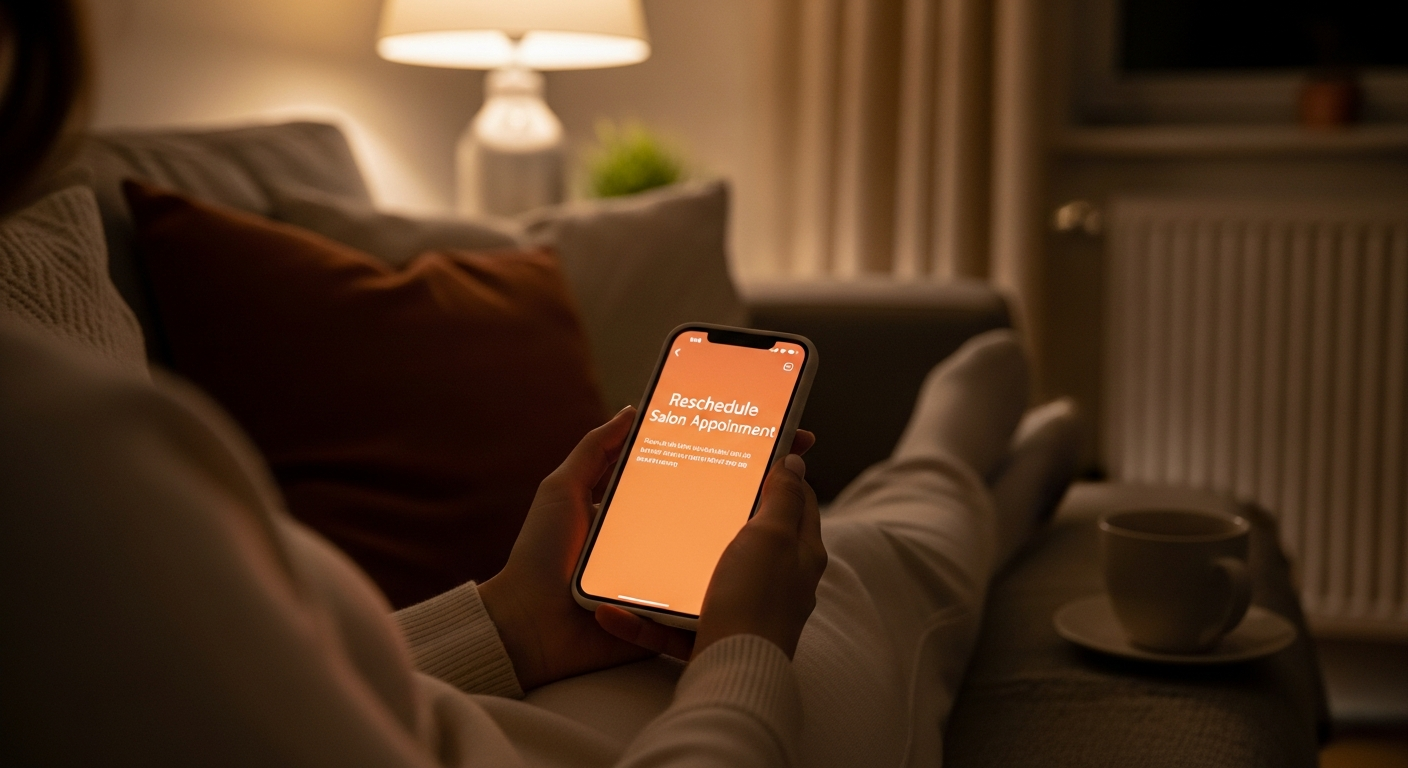
Here's the exact moment a no-show is born. It's 9 PM. Your client is on the couch, finally looking at tomorrow, and realizes the 11 AM color appointment isn't going to work. Now what?
Your salon is closed. Nobody's answering the phone. They could call in the morning, but mornings are chaotic and they'll probably forget. So the appointment just sits there, and tomorrow it quietly becomes a no-show. Not because the client is inconsiderate, but because the gap between "I can't make it" and "let me move it" had no bridge.
That gap is enormous, because so much of a client's mental life around their appointments happens after you've gone home. Nearly half of salon bookings happen outside business hours — evenings, early mornings, weekends — and the vast majority of clients say they want to manage their bookings outside of regular hours. The instinct to deal with appointments at night isn't unusual. It's the norm. Your phone line just isn't there to meet it.
It's the same friction that drives nearly two-thirds of millennials to abandon a salon over a clunky booking experience. When changing an appointment is hard, people don't politely wait. They disengage.
Reminders Surface the Problem. Something Has to Solve It.
Most salons already have a reminder system, usually built right into their booking software like Phorest or Boulevard. That reminder text does important work: it's often the very thing that jogs a client's memory at 9 PM and makes them realize there's a conflict tomorrow.
But a reminder is only half the loop. It surfaces the problem; it doesn't solve it. The client now knows they can't make tomorrow, and they still can't do anything about it until you reopen. Ironically, the reminder can even cause the no-show: it triggers the realization at exactly the hour when there's no way to act on it.
What's been missing is the other half — a way for the client to actually move the appointment the moment they realize they need to, no matter the time.
Closing the Loop with 24/7 Rescheduling
This is the specific gap SalonAgent is built to close. When a client realizes at 9 PM that tomorrow won't work, they don't have to wait for morning and they don't have to remember to call. They can reschedule right then — by voice, text, or webchat — and SalonAgent handles it.
It finds their appointment, offers real open slots that fit your team's actual availability, and books the new time live in your system. No phone tag, no morning callback list, no guesswork. The 11 AM that was about to become an empty chair turns into a confirmed Thursday afternoon instead.
That's the whole shift: a no-show is usually just a reschedule that never had anywhere to go. Give it somewhere to go, at the hour people actually think about these things, and a meaningful slice of your no-shows quietly turn back into kept appointments.
Stop Punishing No-Shows. Start Removing the Reason.
Cancellation fees and deposits have their place, and plenty of salons use them well. But fees treat the symptom. They make the loss sting a little less; they don't address why the appointment was missed in the first place. Worse, a heavy-handed fee can sour a client who genuinely just had a bad day.
The more durable fix is to remove the friction that created the no-show. Let people move their appointment the second they know they need to. Meet them at 9 PM on the couch, not at 9 AM when the slot has already come and gone. You keep the booking, the client keeps the relationship, and nobody has to have the awkward fee conversation.
An empty chair you can never sell twice. But a no-show you can almost always prevent — as long as your salon is reachable at the exact moment a client needs to move things around. That moment is rarely during business hours. With SalonAgent, it doesn't have to be.
Want to see what SalonAgent webchat looks like in action?
Get in touch and we'll show you how it works with your booking system.
Get In Touch